
The battle between the two dominant giants, TMC and BJP.
The history of elections in West Bengal, spanning from 1950 to the present day, has been exceptionally brutal. First the Congress, then the Leftists, and subsequently the Trinamool Congress—all three have followed the exact same pattern. West Bengal, once a developed state, has today been reduced to a backward state due to ‘goon politics.’
Even after 34 years of uninterrupted rule, when Mamata Banerjee removed the Left Front. (Of course, her lagna and planetary alignments must be very strong.) Bengal’s decline continued. The Tata Motors plant left Singur, turning Bengal into an industrial wasteland. This loss wasn’t just economic; it struck at the state’s core. A generation of entrepreneurs was forced to seek opportunities abroad. Calcutta, once considered invincible, began to falter due to flawed policies. The rise of Mamata’s Trinamool Congress over 15 years highlighted this reality: anti-enterprise sentiment had become central to Bengal’s politics. Kolkata, once driven by industry, has weakened under its own policies. This status quo persisted throughout the TMC’s 15-year rule.
📜 Historical Phases of Politics in West Bengal
1. Congress Era (1950s–1977)
After independence, Indian National Congress dominated the state. This period did witness political instability, food movements, and early instances of electoral violence, especially during the late 1960s when coalition governments struggled to maintain order.
2. Left Front Rule (1977–2011)
The Communist Party of India (Marxist) led coalition, spearheaded by Jyoti Basu, achieved a historic 34-year consecutive run in power.
- Positives often cited: land reforms (Operation Barga), rural empowerment.
- Criticism: allegations of cadre-based control, suppression of opposition, and political violence in rural areas.
- Labor unrest and industrial flight (especially in the 1960s–80s)
3. Trinamool Congress Era (2011–Present)
Led by Mamata Banerjee and the All India Trinamool Congress.
- Positives: welfare schemes, infrastructure in some sectors.
- Criticism: continued allegations of electoral violence, “cut money,” and local-level strongman politics.
Migration Reality and The “False Vote Bank” Allegation
- Illegal immigrants are being given:
- Fake documents
- Voter IDs
- This is allegedly done to build a vote bank.
Actual 2021 Election Numbers
From official data of the 2021 West Bengal Legislative Assembly election:
- All India Trinamool Congress
👉 ~2.89 crore votes (~48%) - Bharatiya Janata Party
👉 ~2.29 crore votes (~38%)
➡️ Difference ≈ 60 lakh votes (≈6 million)
“Democracy or demographic shift?
The Bharatiya Janata Party calls the 2021 verdict not just an election result—but a result influenced by alleged Bangladeshi voter inclusion.”
Since no birth chart is available for Mamata Banerjee, and the time of Modi’s chart is also not entirely clear, I have based my analysis solely on the foundation charts of the Trinamool Congress and the BJP, as well as the prevailing Dasha (planetary period) of India—specifically, the Mars-Rahu *Dasha*.
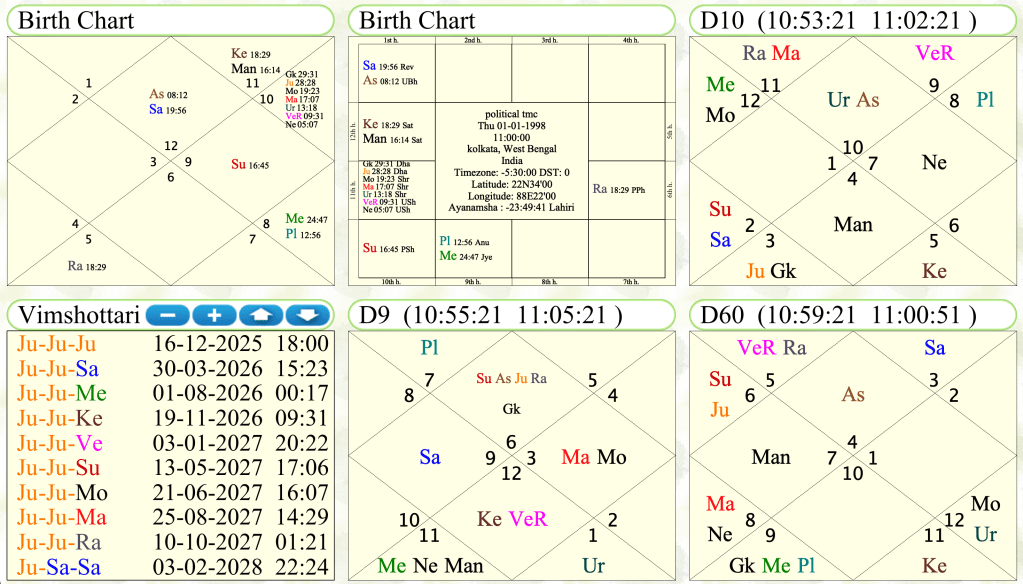
The Mamata Banerjee–led All India Trinamool Congress rose to power in 2011 during the Rahu–Jupiter Dasha—a period that activated a highly formidable planetary configuration.
Rahu placed in the 6th house forms the powerful Ajatashatru Yoga, granting the ability to defeat enemies, often through unconventional or strategic means. The true strength of Rahu lies in its dispositor—the Sun—which is positioned in the 10th house with Digbala in Sagittarius.
This combination signifies a leadership style that is fiercely assertive, tactically sharp, and relentless in holding authority—one that does not hesitate to use every possible strategy to overpower opposition and maintain dominance. As this Rahu maintains this powerful strength in D-9, D-10, and D-60.
The ongoing Mahadasha shift beginning 16 December 2025 marks a decisive phase for the All India Trinamool Congress and its leadership under Mamata Banerjee.
With the onset of Jupiter Mahadasha, the narrative becomes complex. On the surface, Jupiter is Neecha (debilitated), which would ordinarily weaken its ability to protect and expand. However, its conjunction with an exalted Mars forms a powerful Neecha Bhanga Raja Yoga, indicating that adversity itself becomes the source of strength and rise.
Further amplifying this is the Parivartana Yoga with Saturn. The exchange between key houses—especially involving the Ascendant lord and the 11th house—creates a strong network of gains, alliances, and survival through structured power systems. The presence of the Moon (5th lord) in the 11th house adds mass connection, public resonance, and emotional mobilization of supporters.
Yet, this is not a smooth path.
Jupiter, acting as the Gnati Karaka (GK), brings internal conflicts, hidden opposition, and karmic tests within the system. Venus, being the lord of the 3rd and 8th houses, introduces elements of controversy, sudden events, and issues related to public perception—especially concerning women. In this context, incidents that shake public trust, particularly among female voters, become astrologically significant triggers rather than isolated events.
In the divisional charts, Jupiter’s strength appears relatively weaker; however, the D-10 (Dashamsha) tells a different story. The exchange between Jupiter in Gemini and Mercury in Pisces activates a 3rd–6th house dynamic—signifying संघर्ष (struggle), competition, and a relentless fight-back mechanism. This ensures that even under pressure, the system does not collapse but instead responds with full strategic force.
This Mahadasha does not indicate an easy reign—it indicates a battlefield. There will be challenges, internal friction, and image-related setbacks. But due to strong yogas and exchanges, the ability to fight, adapt, and retain power remains very much alive.
BJP’s Astrological Rise: Power, Strategy & Timing
The Bharatiya Janata Party (BJP) chart reflects a Gemini Ascendant, with its Ascendant Lord placed in the 9th house, granting it strong ideological backing, fortune, and strategic expansion. However, the conjunction with Ketu forms a subtle Kapat Yoga, indicating a tendency toward calculated strategy, illusion, and political maneuvering.
The landmark victory of 2014 came during the Sun–Jupiter Dasha—a highly potent period. The Sun, placed in the 10th house in Pisces, gains Digbala (directional strength), symbolizing authority, leadership, and rise to power.
At the same time, Jupiter, positioned in the 3rd house in Leo, retrograde and in Magha Nakshatra, becomes exceptionally influential—amplifying courage, mass communication, and connection with legacy power structures. Its placement in the 10th house of the D-10 chart further solidifies political dominance and administrative control.
On a broader level, India’s current Mars Mahadasha—which followed the Moon Mahadasha (2015–2025)—marks a shift from emotional consolidation to assertive action. The Moon period brought institutional and professional growth, aligning closely with BJP’s expansion phase, while Mars now drives aggression, decisive governance, and conflict-oriented politics.
Election · West Bengal · West Bengal Legislative Assembly
Thu, 23 – Wed, 29 Apr 2026
BJP Under Moon–Venus Dasha: Growth with Strategic Challenges
Currently, the BJP is operating under the Moon–Venus Dasha, a phase that brings both opportunity and complexity.
The Moon, placed in the 6th house in a debilitated state, typically indicates struggles, opposition, and internal challenges. However, its aspect from Mars (the ruler of Scorpio), positioned in the 3rd house, creates a powerful Neechbhanga Rajyoga—transforming weakness into strength. This combination suggests that despite criticism, conflicts, or adversaries, the party has the ability to fight back, reorganize, and emerge stronger.
On the other hand, Venus in the 12th house in its own sign is inherently strong, especially since it is exalted in both D9 and D10 charts. This enhances behind-the-scenes strategy, foreign connections, and resource management. However, Saturn’s 10th aspect introduces a layer of realism and restriction—indicating that results will not be absolute but mixed, particularly in matters connected to fortune (9th house) and sudden developments (8th house).
A crucial strength emerges in the D10 chart, where:
- Jupiter sits in the 10th house (power, authority, governance)
- Venus occupies Pisces in the 3rd house
This creates a Sthan Parivartan Yoga (exchange) between Jupiter and Venus, significantly amplifying political strength, communication strategy, and mass influence.
Election Outlook:
With elections approaching in four states, this planetary alignment clearly indicates that the BJP is positioned to perform better than before.
West Bengal Focus:
In West Bengal, the chart suggests improvement compared to previous elections. However, the combination of Saturn’s restrictive influence and the nuanced Moon position indicates that an absolute majority is still uncertain at this stage.
West Bengal Foundation chart
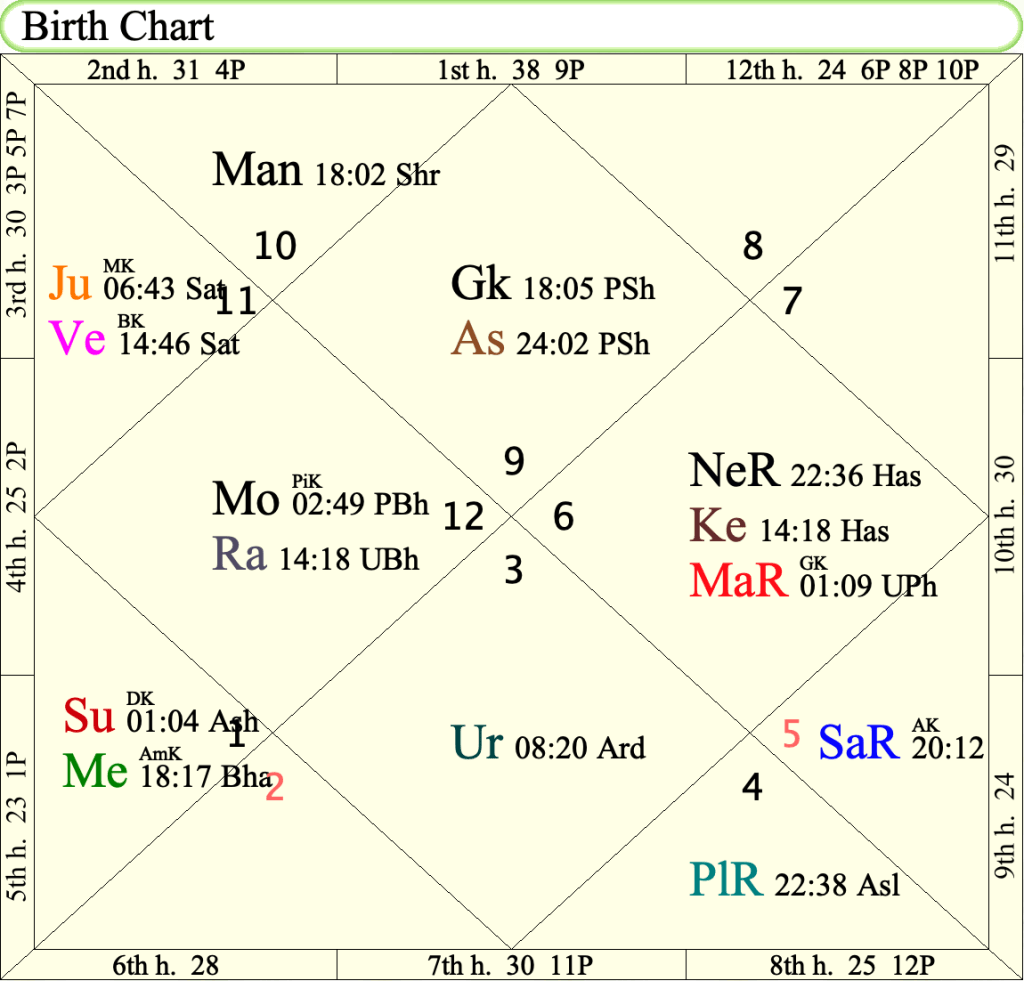
West Bengal is currently running the Moon–Mercury Dasha, a period that strongly activates public sentiment (Moon) and political strategy, communication, and manipulation (Mercury).
A critical combination emerges with Mars and Ketu placed in the 10th house in Virgo, directly influencing सत्ता (power), governance, and leadership. This is not a mild placement—Mars brings aggression and decisive action, while Ketu adds sudden, unpredictable, and disruptive energy.
Further intensifying this is the exchange (Parivartan Yoga) between Mercury and Mars:
- Mercury (narrative control)
- Mars (force, assertion)
This creates a powerful yet volatile dynamic in which strategy and aggression merge.
Mamata Banerjee has explicitly stated that if Hindus do not vote for the TMC, a specific community will “cut them down”; a similar situation occurred in certain Hindu-majority areas during the last election as well. Since the BJP did not take any concrete measures to protect them at that time, it now faces a distinct challenge: to dispel the fear from the minds of Hindus and encourage them to cast their votes.
While elections in Assam, Tamil Nadu, Puducherry, and Kerala are likely to remain stable and controlled, the real storm is building in West Bengal.
Bengal 2026: Power Lies in Narrative + Freebie Strategy
 Astro Kavi