Some years don’t just make headlines—they change the course of history.
1986 was one of those years.
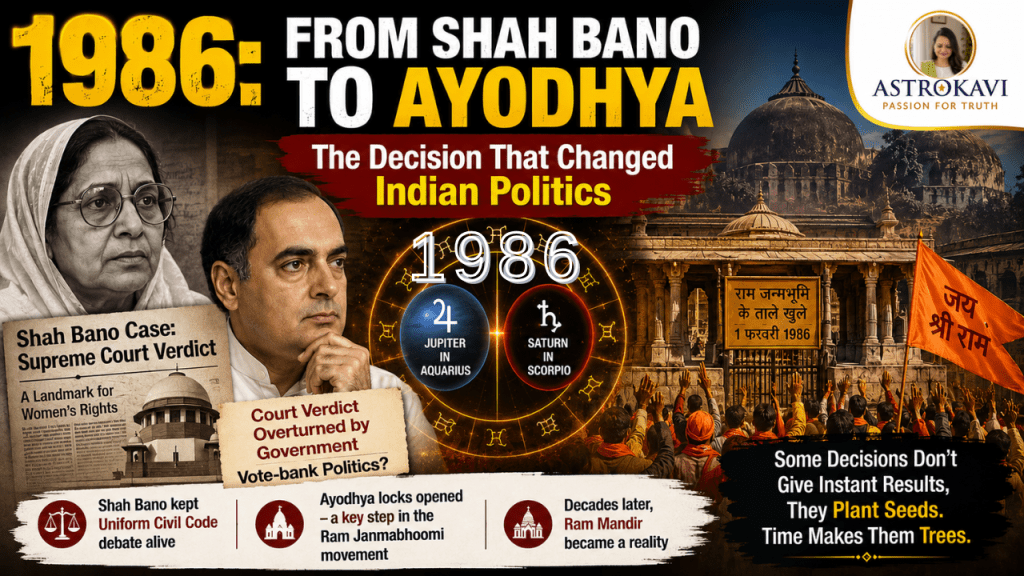
The Shah Bano case was widely seen as a landmark judgment for women’s rights. However, after strong opposition from sections of the Muslim community, the Rajiv Gandhi government passed a law that effectively overturned the Supreme Court’s decision.
Many Hindus felt that the government had compromised justice for vote-bank politics.
Soon after, in February 1986, the locks at the disputed site in Ayodhya were opened, allowing Hindu worship. Many political observers believe this was an attempt by the government to balance the political fallout—trying to reassure both Muslims and Hindus.
But politics doesn’t always work as planned.
Many Muslims remained unhappy over the controversy, while many Hindus viewed the move as symbolic rather than meaningful. Instead of satisfying both sides, the government ended up facing criticism from both.
The political consequences became clear in the 1989 general election, when the Congress Party lost its majority and Rajiv Gandhi was voted out of power.
A Vedic Astrology Perspective
From a Vedic astrology viewpoint, history often unfolds in stages.
Certain planetary combinations don’t create instant results—they plant seeds that take years, or even decades, to bear fruit.
The events of 1986 became such seeds.
- The Shah Bano case kept the debate over the Uniform Civil Code alive for decades.
- The opening of the Ayodhya locks became an important milestone in the Ram Janmabhoomi movement.
- Decades later, the construction of the Ram Temple became one of the defining political and cultural developments in modern India.
Neptune was in Sagittarius (Dhanu), in Mula Nakshatra, during 1986. While Neptune is not a classical Vedic planet, it is often associated with collective beliefs and ideological shifts. Mula Nakshatra is symbolically linked with uprooting the old and planting the seeds of a new order. From that perspective, 1986 can be viewed as a year when deep social and political transformations quietly began.
A Vedic Astrology Perspective
From a Vedic astrology viewpoint, 1986 was not just politically significant—it also reflected powerful planetary symbolism.
- Jupiter (Guru) was in Aquarius (Kumbha) in Dhanistha Nakshatra, highlighting major shifts in society, governance, and collective ideology.
- Saturn (Shani) was in Scorpio (Vrischika), a sign associated with deep transformation, hidden tensions, and irreversible change.
- Mars (Mangal) was also in Scorpio, conjoining Saturn and intensifying the energy of conflict, decisive action, and long-term consequences.
- From Scorpio, Saturn and Mars both aspected Jupiter in Aquarius, creating a strong connection between power, justice, religion, law, and public opinion.
1986 became a “seed year.”
The immediate events appeared political, but their consequences unfolded over decades:
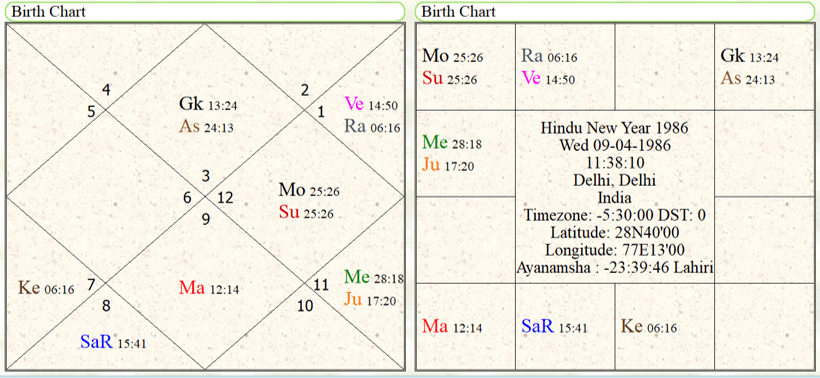
In the Hindu New Year horoscope of 1986 the lord of the 9th house (religion) the Saturn was in the 6th house of conflicts. The 6th lord Mars aspect the lagna (ruler and general happiness of people) and also the 10th house (government) showing a very controversial law imposed by the ruling central government then igniting religious conflicts. The King of the New Year is Mercury which is in the 9th house of religion and supreme court of the country astrologically explaining the just and prudent judgement of the Supreme Court in ‘Shah Banoo Case’ which was over-throne by huge majority government of Rajive Gandhi by enacting a law in the parliament.
- The Shah Bano case kept the debate on the Uniform Civil Code alive.
- The opening of the Ayodhya locks became a turning point in the Ram Janmabhoomi movement.
- Decades later, the Ram Mandir became a reality, reshaping India’s political and cultural landscape.
History records the events.
Vedic astrology studies the timing behind them.
Sometimes planets don’t create history overnight—they plant the seeds. Time, dashas, and transits allow those seeds to grow into movements that change a nation.
 Astro Kavi