
When you are under a favorable planetary ongoing Dasha, even your wrong decisions turn into masterstrokes; however, when that alignment is disrupted, those same poor decisions can damage your image and lead to significant challenges.
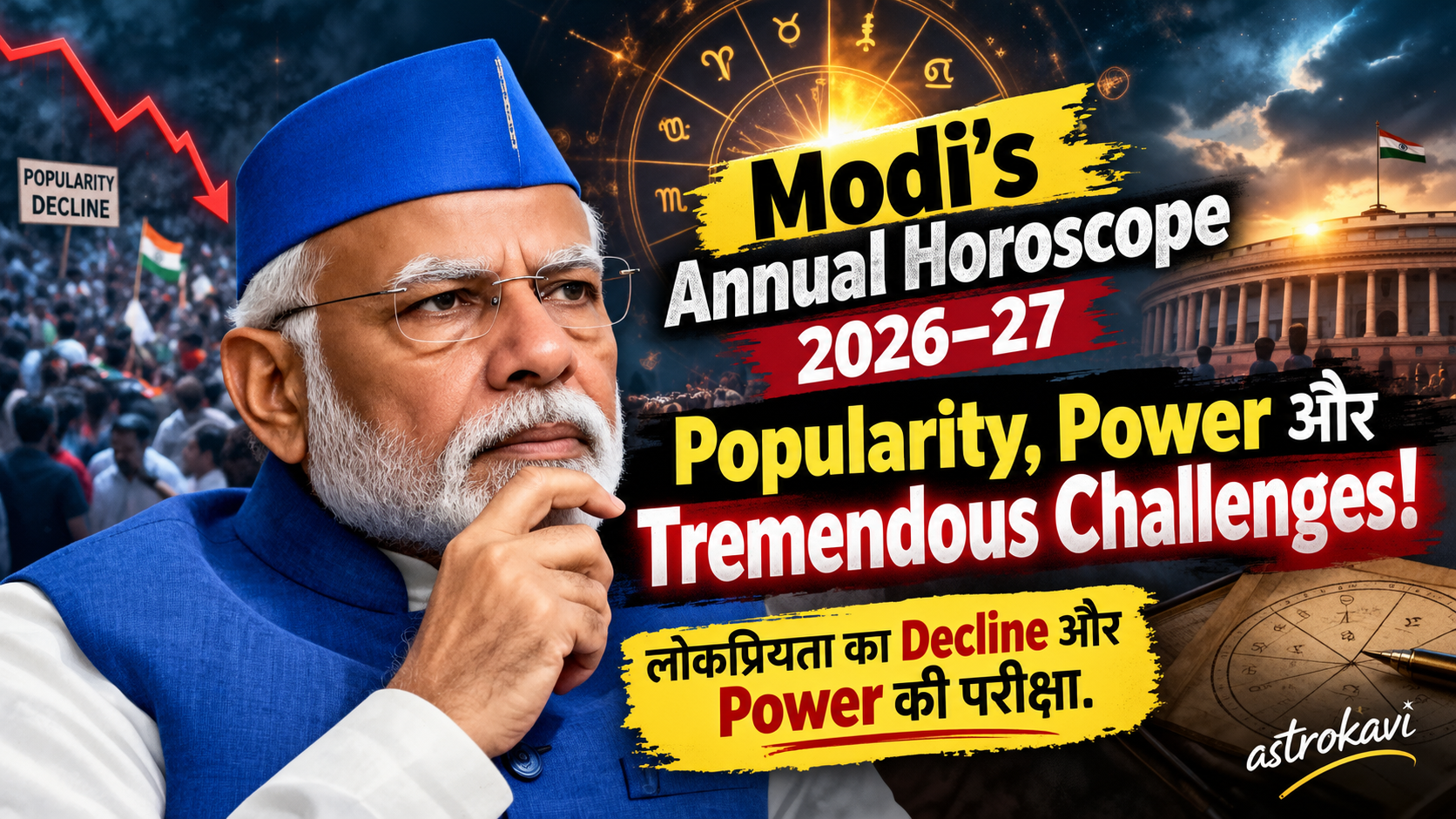
According to Prime Minister Narendra Modi’s annual horoscope for September 17, 2026, to September 17, 2027, the coming year is marked by tremendous challenges, political pressure, and a determined struggle to recover from declining popularity. The planetary indications suggest a period in which every setback may demand a carefully calculated response, while the effort to regain public confidence becomes a central theme.

For a Taurus Ascendant, Jupiter occupies the third house along with the Gnatikaraka, bringing the themes of effort, initiative, communication, competition, and adversarial circumstances into the same field. From a Jaimini perspective, the conjunction with Gnatikaraka deserves particular attention, as it can indicate that the native’s efforts and self-projection may repeatedly encounter resistance, rivalry, or circumstances that compel sustained struggle.
Modi-ji’s chart features a Neech-bhang Rajyoga, and it is his good fortune that the opposition is so compromised; consequently, the Indian public currently lacks a viable alternative.
Jupiter nevertheless provides a mitigating influence to the debilitated Moon. The condition of the Moon should not be assessed in isolation; its dispositor, Mars, becomes an important link in understanding how the debilitated Moon is able to function. With Mars placed in the Punarvasu Nakshatra, there is an indication of repeated effort toward restoration, repositioning, and improvement. This can manifest as a strong awareness of how the native is perceived publicly, along with a conscious tendency to rebuild or refine their image whenever circumstances create setbacks.
However, the Saturn factor substantially modifies this picture. Saturn’s aspect on the Ascendant and the Sun introduces a restrictive and delaying influence over both personal projection and authority-related matters. Thus, while the chart shows considerable consciousness of reputation and a willingness to work toward recognition, the Saturnian influence can prevent immediate visibility or proportional acknowledgement of those efforts.
Why Are Modi’s Core Voters Losing Faith?
Critics are increasingly questioning the harshness and alleged misuse of the SC/ST Act, arguing that a law meant to protect the vulnerable should never become a tool that undermines due process or individual liberty. When an innocent person is dragged into a legal battle, faces arrest or years of litigation, and public money is used for compensation, the obvious question is: where is the accountability?
And what about the UGC controversy? When institutions and constitutional principles become tools in political battles, we have to ask a much bigger question:
Is this not a form of killing the spirit of the Constitution?
The Constitution is meant to protect citizens—not become a weapon for political parties to preserve their position.
A country moves two steps forward when institutions become stronger, fairer, and more accountable. But if political interests repeatedly misuse constitutional institutions and principles for short-term advantage, we risk taking four steps backwards.
Because democracy is not merely about holding power.
It is about using power without destroying the principles that make that power legitimate.
However, despite the challenges, P.M. Modi will succeed in retaining power, but voices of opposition will grow.